Showing posts with label learning. Show all posts

Monday, April 8, 2013

The Value of Shared Experiences


As I tried to write this post originally, I was interrupted by an 8 year old screaming “There’s a RAT in the bean bag!”  Apparently our cat had killed a mouse and hid his trophy in the kid’s bean bag…an offering of affection as it were.  End writing process and begin mom process of community dialogue on a shared experience... 
  • What is the difference between a mouse and a rat? 
  • Why would the cat put a dead mouse in the bean bag? 
  • Why can't we touch dead animals?
  • What are you going to do with the body?


Humans do not live in a community of one.  We live in relationship with others: our families, our friends, our co-workers, and strangers on the street.   We create discourse communities based on shared experiences – like dead rodents in bean bags.  This dialogue helps all of us reflect on the experience, taking new knowledge forward into our lives.  Knowledge accessed via a void, with no dialogue or reflection, at best lives in short term memory, leaving us at a loss when faced with the need to access that knowledge later in life.

I have recently read about The School of One and the concept of personalized learning.  My concern with the focus on personalize learning to the extreme is the loss of dialogue in shared experiences.  Creating a discourse community is still relevant in education today.  Learners in a void do not have the opportunity to engage others in shared discourse.  This hinders the reflective elements of learning, which encourage new or innovative articulations of thought.   I would argue without this opportunity for reflection, for the creation of a discourse community, we are hobbling our students. 

In her book, “Reality is Broken”, author Jane McGonigal writes of the importance of social connection as element of satisfaction and experience of success.  We as humans build “intrinsic rewards, positive emotions, personal strengths by social connections that we build by engaging intensely with the world around us.” (45) Personalized learning privileges the one over the many.  While in some cases this may be temporarily successful, the danger of isolation is very real… holding the learner from others with whom valuable reflection and collaboration could enrich the learning experience.

Practically applied, this means creating opportunities in our classrooms for learning as community.  As educators we can encourage dialogue based on the shared experience of new content (Mitosis to Shakespeare), events (Prom is on the horizon) or skills (Ultimate Frisbee anyone?).  Offering our students time to engage each other, working through experiences together, creating communities of discourse is what we do as professional educators.  

Because that cat is only a year old... and there will be more mice in house thanks to our large wooded lot... retaining this new knowledge is going to be critical.

Toast the Rodent Hunter

Wednesday, March 20, 2013

Lessons Learned in 1:1: Stay on Mission


So students now have devices in their hands... now what?  

The temptation to begin random acts of technology looms.  Students and their families have spent time and money discerning the best device - we want them to use them.   But is a classroom full of students staring at computer screens really what we want?  No...24/7 constant computing was never part of the learning objective and we must push against the temptation to let the machine be teacher.  

In the day to day living, I must admit our learners (those over and under 18) do drift off into Temple Run, Facebook and yes, the occasional Shark versus Octopus video.  I have conversations about potential cost savings of open source and online content.  I still have conversations about "integrating technology" based on an online activity someone saw at a conference and thought it looked cool.  And in all cases (yes, even after the shark vs octopus video) I asked...


"What is your learning objective?"  


It's become a bit trite in my world.  So much so, my husband posted this blog post, "Who Needs Learning Objectives?" by Charles Jennings for The Training Zone, on my Facebook page.  

Jennings, who is not a fan of learning objectives, writes: 
"Remember, learning objectives may be useful to help you create a logical design, but that’s all they’re useful for."

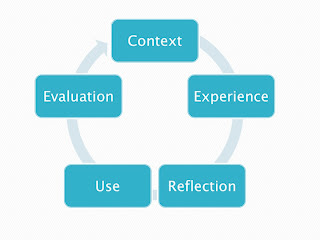
Luckily for us, the learning objectives of access, evaluate and use were used to create logical design.   But we also had another framework to give our 1:1 initiative purpose: the Ignatian Pedagogical Paradigm.  


Insert short interlude on the Ignatian Pedagogical Paradigm... you know... because you all are curious now that #Jesuit is like a major news story....


In brief, the IPP guides the learner much as the retreatant is guided through the Spiritual Exercises of St. Ignatius Loyola.  


By meeting the learner in their contextual environment, creating experiences with knowledge and offering time for reflection... Jesuit educators guide students through the learning process...  With the end goal of developing young people who are intellectually competent, open to growth, spiritual, loving and committed to social justice (affectionately known as The Graduate at Graduation).  


End Interlude and cue...

What are the implications for other 1:1 programs?  


Don't forget your objectives!  Why was 1:1 computing considered and implemented in your learning environment?   

Part of the lesson we've learned is staying in conversation with parents and students.  Distractions will happen.  Yes, access the Angry Birds was fun for the 10 minutes... but under closer evaluation/reflection... was that the best course of action?  Engaging the conversation can be one of the most powerful reflective practices our students will carry forward into their lives.  Learning how to balance the productive power with distraction capabilities is a crucial skill for academic and life success down the road.  Stay on mission... for us, that's developing the whole person.  Even the part going for the high score.

Part of the lesson learned we've learned is staying in conversation with faculty.  The temptations will be strong... online tutorials, virtual field trips, blogging... all which can be valid learning experiences if they are a part of the larger objective.  Otherwise, they can be distractions under the guise of learning.  Engaging online tutorials outside of context may keep students quiet for 20 minutes, but retention of content will be minimum. Virtual field trip experiences without clear (and actually articulated) outcomes are just as much a distraction as a round of Angry Birds... just ask any middle schooler who has recently been on such a journey.  Blogging can mirror the worksheet unless framed in creation and reflection.  Stay on mission...for us, that's ongoing dialogue/PD with faculty (most often in our Teacher Resource Center... over coffee...).

The shiny pretty is by its very nature a distraction. Fight the temptation of random acts of technology.  Stay on mission.  And enjoy those National Geographic videos...


Saturday, February 2, 2013

Learning as Pilgrimage

Confession - I was supposed to be doing housework and I decided to kill some time on Twitter instead. A fabulous colleague @bhobbs63 posted a link to @StrategicMonk's blogpost "Our Pilgrimage is Not a Race".

"Our pilgrimage is not about gaining speed over a distance toward a goal. The point of our pilgrimage is to be aware on the journey....Pilgrimage is about learning, being open to the lessons of each step."

After reading the post, I took some time to reflect while I cleaned...

I had the privilege to go on a pilgrimage once with the Franciscans (we're a dual order household) to Assisi, Italy.  Our guides told us right away to not consider this experience a vacation.  A pilgrimage is not a vacation.  It is a journey with oneself and God - moving closer to unity - experiencing place in the present.
Not Assisi (those pics are on another computer), but pretty...


What if we thought about education in this light?

About now my public school readers are panicking, but never fear... this applies to you as well.  Image education as a journey with oneself and knowledge.  No destination test scores, no end goal spreadsheets full of SLO's, no race to fill the walls of a data room.  What if we knew each student - their gifts and weaknesses - journeying together to experience "school" in the present moment... unified by shared interest in content and open to the ...whatever... that might happen?

Does this mean I am advocating throwing goal setting and curriculum guides out the window?  Not at all.  I am all about setting goals and having a plan (strong J on Meiers-Briggs).  However, sitting in #FETC sessions this week, listening about PARCC and Smarter Balance testing I could not help but think we've gone too far.  We let ourselves focus on outcomes to the detriment of the individual.  The journey has become about an imaginary, norm-referenced finish line.

Yes, I am dreaming.  And yes, I may have inhaled too much bathroom cleaner. But here's the thing - down at #FETC this week, every conversation I had landed on the importance of personal relationships: between teacher and student; administrator and teacher; school and home... Being present in the moment with each other, unified in the journey of learning, was the topic on many minds - not destination items such as test scores and SLO's.  And we build these relationships when we let go of school as business and open ourselves to school as pilgrimage.  A journey of many little steps, unified by content and shared experiences in the present moment.

Learning happens everywhere!


Wednesday, May 16, 2012

Invisible Integration: The Challenge of Communicating Progress

Lately, @jdferries and I have been doing a lot of talking about 1:1 BYOT to constituents.  One challenge of communicating progress lies in the visualization what is essentially invisible integration.  We didn't go out and buy 800 of the latest, glossy marketed shiny pretty device.  We chose the apparently radical route of encouraging choice in technology - which is exactly what all the shiny pretty marketing campaigns tell us we should do... at home.  


Let’s take a journey back in time and situate ourselves in the historical context of instructional technology.  Thanks to Rodney Earle's article, The Integration of Instructional Technology into Public Education: Promises and Challenges (2002), instructional technology has been defined as....


  • a systematic way of designing, carrying out, and evaluating the total process of learning and teaching in terms of specific objectives, based on research in human learning and communications, and employing a combination of human and nonhuman resources to bring about more effective instructions. (Commission on Instructional Technology, 1970)
  • [Instructional technology] is concerned with improving the effectiveness and efficiency of learning in educational contexts, regardless of the nature or substance of that learning. …Solutions to instructional problems might entail social as well as machine technologies. (Cassidy, 1982)
  •  Instructional technology is the theory and practice of design, development, utilization, management, and evaluation processes and resources for learning. (Seels & Richey, 1994)


  To be clever – I put the above definitions into Wordle to make my point… 

Apparently, instructional technology is all about learning.  So Mr. Earle is correct when he wrote (10 years ago), “Integration does not just mean placement of hardware in classrooms.” (Earle, 2002)

Let’s say it again shall we... “Integration does not just mean placement of hardware in classrooms”.  I couldn’t agree more.  I think I have been clear in my opinion that education is spending way too much time on the hardware (nouns).  The challenge of communicating progress with technology is… nouns are visible.  I can touch, count, take marketing photos of… hardware.   I can create push button trainings for... hardware.  I can create a single jailbreak to dismantle cameras... for hardware.  Quite frankly, just as they are the easiest part of speech to identify on a standardized test, nouns are the easiest instructional technology element to control student access, market to the school board and lecture about in trainings.

But you can ask my mother… I seldom take the easy path.

Learning is hard to photograph.  Learning is hard to control.  Heck, as current discourse shows, learning is hard to measure with any tool, test or imaging machine. Oh sure, we say learning … a lot… but reading on we get side tracked into products, devices or matrixes designed to measure learning… but we losing the subtlety of the process of learning - context/experience/reflection/action/evaluation. 

So how do we visualize verbs to showcase instructional technology for our constituents (and the occasional newspaper we are trying to encourage to cover the magic - yes you - @indystar and @criteriononline)?  Borrowing some ideas from others (most generally the Northwest Regional Educational Laboratory) here are a few ideas.

Is technology in the classroom embedded in the curricular objectives?
I’ve said it before, but the curricular objectives MUST dictate tools used.  More often than not, a highly integrated classroom will have students working with a varied of tools at a variety of stages.  I am most concerned when I see a room where every eye is glued to a screen.  State of the Art is not shiny pretty, silver screens broadcasting the same information, in the same mode to all students.

*This does require someone walking into a classroom - not just reading aggregate data in a spreadsheet.

Problem solving and higher order thinking is evident in classroom activities.
Notice the “classroom activities” part of this one.  Not in the homework.  Not in the assessment.  In the actual, observable activity taking place in the classroom, students are synthesizing, suggesting solutions, experimenting.  These classrooms are often loud, with students working with a variety of tools.  To some, this might look like chaos.  (These pictures seldom make the newspaper except for articles with the title “Kids Today!”)

*Again, this does require someone walking into a classroom - not just reading aggregate data in a spreadsheet.

Students independently chose the technologies appropriate to their learning objectives.
You knew I’d get to BYOT eventually!  This is part of that “problem solving” piece.  It takes a high degree of critical thinking to determine the best tool for the job.  Empowering student to make that choice is no longer an option.  Instructional technology as "concerned with improving the effectiveness and efficiency of learning in educational contexts" is not just the arena of PD officers and teachers.  State of the Art is allowing for differentiated content acquisition/engagement modes and individualized demonstration of mastery .

*Yet again, this does require someone walking into a classroom - not just reading aggregate data in a spreadsheet.

As we like to say around here - integration is happening best when it's invisible...and not a classroom full of hardware. Communicating progress in a noun driven world though... that's a real challenge.