Showing posts with label Catholic Education. Show all posts

Sunday, July 2, 2017

Faculty Formation: Yes, This Is For All Types of Schools!


One of the great joys of my day-job is running the first and second year faculty/staff formation program.  The good people at Merriam-Webster define formation as “the art of giving shape to something.”   So we meet as a cohort once a month to read, reflect, discuss, articulate, and shape ourselves according to our Jesuit heritage and our Brebeuf mission.

Yes, friends, it’s going to get a little Catholic Jesuit deep here… but the big ideas are still valid in ANY educational setting.  I would even go as far as saying critical to all settings – and quite noticeable when missing.

Claim Your School’s Mission
“Brebeuf Jesuit, a Catholic and Jesuit School, provides an excellent college preparatory education for a lifetime of service by forming leaders who are intellectually competent, open to growth, loving, religious, and committed to promoting justice.” (full mission and core values are here… it’s worth a look).

As my debate teaching husband would say:  Name It (a Catholic and Jesuit school); Claim It (provides an excellent college preparatory education for); Prove It (a lifetime of service by forming leaders); Conclude It (who are intellectually competent, open to growth, loving, religious and committed to promoting justice). 

It Starts With Orientation
I start with our two-day orientation program.  Day One is what I call “The Nitty Gritty” day… how to print stuff, online gradebooks, location of bathrooms, get keys… all that day to day stuff.  Day Two is “Mission and Identity” day.  I start with a brief introduction to the Society of Jesus and Jesuit education.  We then explore and catch new educators up to some of our of cura personalis initiatives (student stress lately) and then send the new faculty and staff off to the Freshman Day of Service activities with our Community Service Director.  Immediately claiming who we are… and how we are operate in our Catholic Jesuit learning environment.  

Formation Cohorts
For two years, all new faculty and staff are required by contract to participate in what we call the Magis Program.  Yes, you heard me… required by contract.  Everyone but Buildings and Grounds (who are welcome but schedules are hard to coordinate).  These cohorts serve two main purposes: they create groups of supportive colleagues in new setting and they act as personal learning cohorts on topics of mission and identity.  The structure of the program starts with information (Context), moves to practical application (Experience), then to Reflection (Retreat), one to deeper dive (Use) and finally to a capstone project (Evaluation).  Whhaaaaa… the Ignatian Pedagogical Paradigm is the structure of the formation program.  Craziness J

Structure Your Program Based on Your Mission, Teaching Paradigm, or Educational Foundation
Shape the mission of the school through its teachers and staff.  Make the mission alive in all aspects of the workings of the school and watch the awe and wonder begin.  Seriously… and it might even increase test scores!  

Here’s our program at Brebeuf as example.

Context:   
First semester focuses on larger issues of Jesuit education and history.


Experience: 
Second Semester focuses on practical life in a Jesuit school.  The main objective being taking the theory/history into daily practice.

  • The Classroom/Workplace as Holy Ground
    • “The Classroom as Holy Ground” by Kevin O’Brien, SJ. From America  May 26, 2003.
    • “Unfinished Houses” by John McLoughlin from America July 21, 2014 http://www.americamagazine.org/issue/unfinished-houses
    • Discussion topics: Church;  Prayer (Individual, Communal, Spiritual Exercises) ; What is Holy Ground
  • Care of the Person
    • “Cura Personalis” by Peter-Hans Kolvenback, SJ.  From Review of Ignatian Spirituality, Number 114.
    • “Care and Concern for Each Individual Person” Excerpt from Characteristics of Jesuit Education (JSEA) page 9 Original found at http://community.jsea.org/mod/resource/view.php?id=162
    • “Choosing to Care” by Katy Ridnouer.  From the book Managing Your Classroom with Heart 2006 pg 9-18.
    • Discussion topics with Student Panel: Cura Personalis – what it is and isn’t; how care is lived in action


Reflection : 
All faculty and staff are required to participate in the Midwest Province retreat “Ignatian Themes” the summer after the first year of employment.  This is a 2 day retreat.  All funding for travel and registration is covered by the school.

Use: 
Year Two is a deeper dive into the theory and practice of Jesuit education and the formational documents of the Jesuit Schools Network (formerly Jesuit Secondary Education Association).
  • Context and Reflection on Ignatian Themes Retreat Overview
    • “Four Hallmarks of Jesuit Pedagogy:  Prelection, Reflection, Active Learning, Repetition” by Ralph Metts, SJ.  From JSEA.
    • All of the IPP readings are on the JSN website .
    • Veteran Faculty Speaker

  • Experience
    • JSEA Foundations “The Preamble"
    • Key Questions:
      • What techniques do  you use to install a sense of awe and wonder in your students/interactions?
      • What techniques have you seen another use?
      • What tensions/balance do your students/constituents struggle with?  How do you offer experiences to guide them to an Ignatian response? (see paragraph 11)
    • Veteran Faculty Speaker
  • Reflection
    • “Foundations: Reflections on the Educational Principles of the Spiritual Exercises” by Robert R. Newton.
    • Look at various forms of reflection (Examen, journaling, prayer)
    • Key Questions:
      • Review of Spiritual Exercise and relationship between Retreatant – Director – Creation and how it related to Teacher – Student – Knowledge
      • The purpose of Jesuit Education “the knowledge, the love and service of God.”
      • Why is reflection so key to learning?
      • How do we engage the affect elements of learning?
    • Veteran Faculty Speaker
  • Action/Evaluation
    • Read “A Fire the Kindles Other Fires” from GC 35
    • Culturally Responsive Teaching (see handout from St. Ignatius San Francisco).
    • Key Questions:
      • How do we live this mission in action in our school?
      • How do we live a compassionate response to the world, community, students, families?
      • What frontiers are you called to?
      • Review Ignatian Identity Review and how used to move school to Action/Evaluation
      • Review the Five Steps of IPP Handout
      • Intro the application project for the next 2 months


Evaluation:  
Participants are then charged to work with a mentor on intentional use of the IPP in their classroom or workspace.  This is the reflection they turn in to “graduate” from the program.


Wednesday, March 8, 2017

Rethinking Faculty Evaluation and Professional Growth


Full disclosure.... using this post to process an idea.  So if you are inclined to discuss - feel free to comment.  If you work with me  - don't panic.  My ruminations below are all in the idea stage!

Here we go :-)

Our current faculty evaluation system here in Indianapolis is about 10 years old.  In true Ignatian Pedagogical Paradigm (IPP) fashion, the time has arrived to move into the evaluation stage. Is the process serving faculty needs?  Is the process encouraging the kind of growth we anticipated?   To give you content, our current evaluation program looks like this:


This model is built on the foundations of Marzano, Downey, Wiggins and McTighe.  Through a series of standards and indicators, evaluating administrators and faculty discuss successes and failures in the classroom... culminating in a year end meeting.  Evaluating the process, we find a weakness in meeting needs of new and experienced faculty - both who are lumped in same process.  We find that formal observations and informal walkthroughs work well for early career teachers who are new to our methods and expectations.  The indicators and focused discussion builds a foundation for them.  However, we are not seeing the growth process with mid-career faculty.  Veteran faculty quite frankly know the elements of day-to-day teaching but do not feel challenged to really innovate. In an nutshell, our challenge has become less one of evaluation (Are you doing your job?) and more one of professional growth (How can you better develop your craft?).

As Jesuit educators we a challenged by the 1st Principle and Foundation “…we show reverence for all the gifts of creation and collaborate with God in using them so that by being good stewards we develop as loving persons in our care of God’s world and its development…”  As a public school educator I might have translated this to say “My gifts and interests are meant to be shared and I choose to share with my students so they can grow and care for the world.”  However you interpret – a challenge as an educator is to recognize and articulate professional gifts and limitations.  Once gifts and limitations are articulated, then a professional begins to desire opportunities for growth.  

Great, Jen… but what does this have to do with faculty evaluations in schools??

What if we separate evaluation from growth in our processes?  This is not all my idea… The IndependentSchool Management firm thinks the idea of separating is possible and even preferred. Taking a page from higher education tenure processes - what if we ask the deeper questions regarding life as a scholar?  Can I as faculty articulate my identity as a scholar?  What do I offer to my department/university that is unique to my gifts?  I strongly feel we should be having this conversation in K-12 to focus on growth rather than simple evaluation.

Taking this idea into my school context,  we create an evaluation around the Profile of an Education Educator plus some basic professional expectations to create an evaluation to quickly communicate “meets/does not meet” expectations for employment in our schools.  (For those wondering, Brebeuf Jesuit operates with year-to-year at-will employment agreements).  Maybe it could look like this:

Meeting expectations communicates that a faculty member has a job next year
(barring anything unexpected with enrollment and finances).  With evaluation out of the way, then faculty and supporting administrators could focus on the real work necessary for improving our learning experiences – professional growth.  Setting goals that stretch teaching methods, innovate assessment and just plain energize the classroom away from the fear of “will I have a job if this fails?” So, instead of checking the "do you lesson plan effectively" indicator, I am asking:

  • What is your personal identity and mission as an educator?
  • Why do you hold these values?
  • How do you values support the mission of Brebeuf Jesuit as we develop students God-given talents as a responsibility and act of worship?
  • How do you express your mission within your department?
  • What do you need to bring these desires into the classroom?


Diving into the questions above through a process of self-reflection, dialogue and action might lead to deeper professional growth.  Growth that would encourage my desire that all our faculty discover the classroom as a place of awe and wonder and not just a paycheck. 


Saturday, August 13, 2016

The Power of Daydreaming


My son was in 1st grade when he came home from school full of excitement.  “MOM!  Today I learned how to dream with my eyes open!!!” To William, the ability to dream anytime/anywhere was the educational highlight of his short life.  He started middle school two weeks ago and so far – he’s still daydreaming and growing in his imagination.

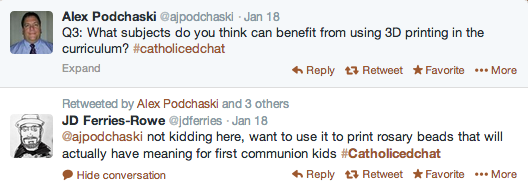
Today on #CatholicEdChat, a thread began on daydreaming.  Admittedly, I overslept (is there such a thing after the first week of school??) and missed most of the thread. But it got me thinking about the power of daydreaming.  Then this happened:


Thus inspired (and renewed by 11 straight hours of sleep) the tweet encouraged me put fingers to keyboard for a quick, rainy day blog post.

St. Ignatius believed in the power of daydreaming.  He used words like imagination, reflection and contemplation.  In his development of The Spiritual Exercises, St. Ignatius challenges the retreatant to imagine “the labors of the journey to Bethlehem, the struggles of finding a shelter, the poverty, the thirst, the hunger, the cold, the insults that meet the arrival of God-with-us.” (a great post on this topic can be found at IgnatianSpirituality.com here). He knew that daydreaming gave us time to change, grow and identify our desires.  More modern educational theorists such as Dewey, Piaget, Egan and Montessori write on cognitive and social growth in imaginative play/study/work.  Our imagination is where learning turns into understanding.  

For me as a Jesuit educator, reflection is where I take all my experiences of the day, allowing them to swirl around my understanding of the world and either fall into place or be discarded.  My daydreams are where I stop inputting new information and begin to play, reflect, mix and match the sounds, images, feelings and actions of the day.  It’s where the pieces fall together.

So why do we criticize students for daydreaming?  Why do we block windows so students will focus on learning?  Why do we cram our teaching with words and more words?  Why must every moment of the school day be scheduled and planned?  Over 20 years ago, Brebeuf Jesuit took the still radical approach of creating Personal Responsibility Time (PRTs) into the school day.  These are 15-40 minute blocks of time for students to take responsibility for their learning.  Some study, some meet with teachers, some play intramural sports, meet as a club or throw a Frisbee around... some sit and stare out the window.  And officially, the earth still spins on its axis.  Students can and should have moments all their own during the school day.

As the new school year begins, I challenge us all to offer times for daydreaming to our students.  And while you are at it, find a little time for yourself to take a breath and let your mind wander.  Albert Einstein is quoted as saying, “Imagination is more important than knowledge. For knowledge is limited to all we now know and understand, while imagination embraces the entire world, and all there ever will be to know and understand.”  Words to dream by.


Monday, May 2, 2016

Old School Discernment in the Digital Age

I get asked a lot about decision making in my job.  As an assistant principal, I can go from hiring to student conduct to event set up to state reports in a matter of 10 minutes.  While I am in no ways a perfect decision-maker, I have learned a few things over the years and most recently in Ignatian Leadership Seminars.  This post is built off a webinar I recent gave via the ISTE Connects Professional Learning Series (ISTE members can find the free webinar here – sorry about the pay wall folks). 

Old school discernment holds up quite well in the digital age.  While we may be making decisions about 1:1 programs, 3D printing, virtual reality or interactive screens, the process of decision-making via discernment holds.  As a Jesuit educator, discernment for me comes out of St. Ignatius’ Spiritual Exercises. The elements of Ignatian Discernment are:
  • A choice between two or more “goods” - discernment requires smart options 
  • The process is dynamic - discernment requires freedom of action and reflection
  • Feelings matter – trust those feelings of excitement, fear, calm, anxiety
So what does this look like in a 21st century example?  In 2009, the technology team at Brebeuf Jesuit began to discern what a 1:1 program at the school would look like.  Feel free to peruse old posts on this blog as to the details – but in a nutshell:

  • No matter what was chosen (Bring Your Own Technology, single-platform, continuation of carts) the priority was the student learning experience.  The choices could all work – and indeed had in many schools.
  • The discernment process ended up taking 2 years.  The time was filled with conversation, surveys, workshops and pilot programs.  At times, one option would outweigh another and the school created “what if we….” trials to see the real life experience of a choice.  Reflection allowed us to choose what was best for our students.
  • Oh the feelings – anxiety, resistance, enthusiasm, excitement were all handled respectfully.  The whys behind the feelings were considered. Many a digital aged initiative has failed because administration did not respect or address the feelings of those affected by the change.
So big picture discernment is about the choice between good choices, accepting a dynamic experience and attention to feelings.  What does the process look like in the details of digital age decision making? 


For me, the process looks something like this:

Phase One – Setting the Context
  • Identify the need to be addressed as concretely as possible
  • Gather all necessary information – data, interviews, sample products  
At this point, the team has a stated decision based on a need for change, choices between goods and is ready to move into an experiential phase. The catch here is detachment.  Change-makers must remain open to options and remain flexible at this phase.  Attaching oneself to any single choice will derail the process.

Phase Two – Experience
  • Evaluate advantages and disadvantages of choices – this may involve pilot programs, test groups, visiting another school. 
  • Test reasoning with self and others - now is the time to play with alternatives.  “What if we….”  “What would our school look like if….?”  If you have a school board or colleagues in the field, ask them to review your plan.
Again, remaining detached is key.  At this point, you may see “camps” in your decision-making team.  People start to become attached to a side and may stop listening.  The team leader should feel comfortable reminding the group to remain detached.

Phase Three – Deciding to Decide
  • Make a tentative decisions – For thee record not making a decision at this time is in fact a decision.  Maybe the context and experience phases have shown it’s not a good time to change.  That is an acceptable decision.  Some tentative decisions are easy – the best choice has made itself clear along the way.  Sometimes the tentative decision is fraught with anxiety.  Listen to that anxiety.
  • Live with the tentative decision for a set period of time.  This is the infamous “let’s sleep on it” stage.  What feeling arise in the decision?  If anxiety – why?  Are the reasons a deal breaker or feelings that can be lived with?  If excitement – why?  How does the team transfer that excitement to a larger group?
  • Finally, confirm the decision even if the team is not 100% on board.  Consensus is tricky business, but if the discernment process has been given time, consideration and detachment the group is ready to move.
Thankfully, good decisions show some signs along the way.  A good decision leads to movement.  When the team starts easily talking about next steps and the fun of the process, you are on the right track.  A sometimes difficult criterion in strong hierarchical groups is discernment made in freedom.  Good decisions happen outside of mandates, fear or reactive situations.  A good decision involves all affected by change.  All voices feel heard along the way, even if the decision was not made in their favor.  Finally, a good decision spirals a school to deeper knowledge.

For Brebeuf Jesuit, our 1:1 BYOT decision quickly engaged faculty and students in the possibilities it opened up.  Because 1:1 grew out of student and classroom needs, the ownership was in the hands of the learners, those who would use the technology day after day.  And over the years, this one decision has guided us in curriculum review, classroom redesign and new teaching practices.  We’ve learned a lot!  And grew as a learning community.

This is a rather long post so thanks for sticking with me!  More posts to come as I continue to gather ideas on pitfalls to avoid and conversation starters.  As always, comments welcome below!


Monday, January 19, 2015

The Teacher Resource Center (aka TRC)... Every School Should Have One

I was reminded this morning by the fabulous Nancy Caramanico that we talk a lot about our Teacher Resource Center (TRC) but have never really explained what it is and why it was created.  Well... nothing like a request :-)

I wish I could say that the idea of a playground for faculty (what we would call a MakerSpace in 2014) was all well thought out and planned.  But it wasn't.  The space was original made to house a special collection library from the Liberty Fund and function as a reading room for adults.  Admittedly, JD and I saw a bit broader application to the space - and we acted on it as soon as possible.  Of course, the Liberty Fund collection is still present in the room.

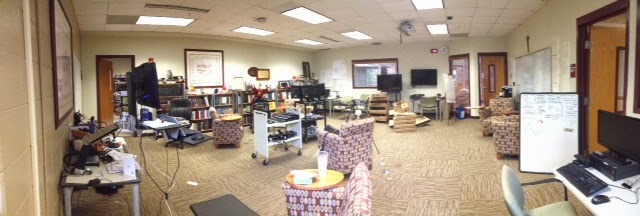
Panoramic shot of TRC during tech week
Purpose

In keeping with our Ignatian foundation, the TRC is a space for faculty and staff to experience and reflect on practices.  This can be as formal as an after school Ignatian Themes formation class or as informal as doughnut Thursdays.  The space is across the hall from the current library and will be remodeled as part of our Information Commons.  Visitors find comfortable/flexible furniture, web meeting software, a 3D printer,
complete set-up of classroom Extron system to experience and many print/electronic/human resources.  We also have a Keurig coffee maker and snacks (usually - Social Studies is quite the group of hunter/gathers and often clean us out).  Basically, anything a teacher would want to try before going into the classroom - we have the space to play.

Beyond space is the human relationship element.  In the picture above, you'll see three doors.  The door at 3:00 is my office.  While I moved into that office as Director of Faculty Development... I stayed when my responsibilities broadened out to Assistant Principal.  Why?  I like being close to the action of information services... I have more casual conversations about curriculum, technology integration and the values of DC over Marvel comics than I would if I had moved to the administrative suite.  For me, the relationships fostered by my location, and the ability to sit and have a cup of coffee with a colleague, trump anything else.

The door at 1:00 goes to the hall and the library.  The proximity to the library, and future integration into the Information Commons, highlights our resolve that learning, research and reflection is not just for students.  Students see adults engaged in new experiences, collaborating or working quietly... great modeling!

The door at 9:00 leads to IT offices.  Of course - you want to be close to the troubleshooters!   And yes, that is JD's mess about 7:30.  As I said in previous post, you have to make a mess to make progress and JD is the living image.

Reflection

Our 1:1 BYOT program was thought up, piloted, reflected on and implemented in the TRC.  From everything to chalk-talks to Tech Petting Zoos to department Boot Camps... we did it all in the TRC.  I strongly suggest anyone even considering a 1:1 or major technology or curricular shift create a TRC - a safe space for conversation and trial experiences.

What I did not anticipate is the organic conversations and connections made in the space.  Teachers meet in the TRC as grade level teams because the furniture allows for easy collaboration.  Cross-curricular discussions start up daily over the coffee maker.  Even students have been invited in to teach adults
how 3D printing can be used in the classroom (this will change with renovations as students will have their own MakerSpace in the Information Commons).  The space is used beyond any one technology initiative... discussion of curriculum, policy, evaluation process and assessments, architectural design, summer camps, athletics ... it all takes place in the TRC!


Key Elements

  • Flexible furniture!  You'll want to re-arrange space for large/small, formal/informal groups as well as individual work spaces.
  • The room cannot be on the meeting room schedule. We protect the space for organic experiences by keeping it off the Outlook room schedule.  
  • Everything in the classroom is present and available for faculty to try.  The TRC was a safe place this summer as we trained, practiced and reflected on the new Extron system installed in all classrooms.  This ensured on Day 1 that faculty were ready to go.
  • Don't forget print resources... some folks still like to curl up with a print book on curriculum design or classroom management and that's okay.  We cater to all users.
  • Quick access to people who can help.  In our case, the proximity to IT, Librarians and Administrators has made for quick actions to identified challenges (small and large).
  • And coffee really does help...

In the new space, the TRC will be a little smaller.  It's okay...really.  Through experience we have learned that the room is best used for small groups or 1 on 1 troubleshooting/brainstorming.  An intimate space for personalized support.  All the doors and offices stay put so the human side will not change.  Plus we'll have a great new space outside the door for collaboration with others!  

So that's the TRC in a nutshell, Nancy :-)  Glad you asked!!

Tuesday, June 17, 2014

Hello Blog... It's Been a While


Permit me a moment of reflection... and to just start writing again.  I’ve been learning how to be an Assistant Principal these past few months.  While I do not pretend that I know it all, I’d say I am at a healthy 38% “got a handle on this thing”!  I am coming up for air and thought it was time to jot down some reflections.

Looking through my Leadership Seminars journal (shameless JSEA pandering) over the past months, a couple of themes recur as I make the transition from ed tech to whole school context:

  • Ghastly Emotional Scenes (GES) happen.  The trick is not to get caught up in the drama.  
  • Be careful of the Eye of Mordor Syndrome.  Running one’s cursory glance over the land to settle with razor focus on one unsuspecting soul.  Not fair to anyone to have an overwhelmed administrator suddenly focus and get in the way.  Trust and relationship builds success.
  • At the same time, don’t isolate yourself.  Trust and relationship builds success.
  • Accept tension.  Tension is not bad.  Tension reminds us that students, teachers, curriculum, wellness are not an “All or Nothing” to be fixed, solved or fired.  
  • It does not all have to happen today.  
  • Be yourself – I am still an introvert.  I am still pastoral in my leadership style. @JDferries still annoys me from 3 feet away….


In her book “Seven Sacred Pauses”  author Macrina Wiederkehr writes  for morning prayer, “…May I live with the kind of presence that enables others to feel at home.”   In the daily rush and muck of administrative life this has been my prayer most mornings (outside of frantic Help Me! intercessions to varied saints). 
After that – the rest falls into place.


Happy June to All!

Wednesday, March 5, 2014

Virtual Learning Days and the Winter of '14

 On a cold day in mid-February, The Indiana Department of Education opened applications for their Distance Virtual Learning program.  The application qualifies schools to request Virtual Learning Days to cover closures due to inclement weather.  On February 26, I received the official word that Brebeuf Jesuit was approved for the IDOE Inclement Weather Virtual Learning Option.  In plain words – if we had to close due to snow we could officially take school online and it would count for our mandated 180 days.

In my ideal world, we were going to have at least 9 - 10 months of dialogue, reflection and pilot lessons with the idea of hosting a Virtual Learning Day.  I am most comfortable working in collaborative process which takes a little time.  For better or worse, Mother Nature appeared to have great confidence that we did not need that much time…. Weather predictions for a major snow event began even as I read our approval email.

Context

Brebeuf Jesuit is well positioned to hit the ground on a Virtual Learning Day.  Our faculty have been 1:1 with tablet based PC’s since 2006.  We've been cloud-based with an LMS since the same time.  Two years ago we went 1:1 across the whole learning community with our Bring Your Own Technology initiative (see any previous post).  We are a Google Apps for Education school.  Teachers and students are very comfortable in cloud-based environments. And as you might have read in my previous post, we had experimented most of this brutal winter with keeping the learning moving forward in virtual environments.

But a five day turn around was going to put us to the test on how flexible we really are.  So what happened?  


 Experience – A Timeline 

Wednesday, Feb 26th….
Receive notice from IDOE that we are approved for Virtual Learning Days. 

I sent out message to faculty and staff announcing our participation in the program.  In consult with Principal, we come up with an outline of expectations.  This was all done by email. 

The email read in part: 
If we would need to take an Virtual Learning Day yet this year, the IDOE is well aware of our infrastructure, access processes and teacher talents in online learning activities.   However, I will need to submit evidence of student virtual learning.  I am requesting the following:

1.       Edline as Home base
a.       Only for classes that would meet the day of Virtual Learning
b.      Announce Virtual Learning objectives by 8:30am the day of school closure via Edline News item on your class page. 
c.       Link any videos, handouts, readings, planned Twitter chats, Google Hangouts, etc. to that News announcement with clear directions of what student is responsible to complete/prepare/produce.
d.      Our future weather closure notice will include directions for parents and students to check Edline for Virtual Learning instructions.
2.       Secondary sites such as Twitter or G+ Community are fine but make sure the News item on Edline is posted first.   This will clearly articulate learning goals to students and parents AND make it easy for me to collect evidence to submit to IDOE.
3.       Be prepared to send me a sample of student work after the Virtual Learning Day.  The IDOE will request evidence of “time on task or learning growth”.   
  

Reflection:  Email is less than ideal… especially in this case as the winter storm was already being heavily discussed.  On reflection, my excitement to share information took over. More face to face conversation, even in the hallway was needed.


Here’s the thing though… almost immediate the brainstorming started to fly. 

Thursday February 27- Friday February 28

Utilizing YouTube video, online discussion forums, readings, flip videos, Twitter, Edmodo, Google Docs and many other resources… the 27th and 28th  I spent reading lesson plans, talking on the phone and in the hallway…faculty collaborated...ideas were thrown around...

An Ed Tech Newsletter was created to give further samples to clarify expectations. 

Saturday March 1- Sunday March 2


I watch as News items were posted on class pages in the LMS as requested….we were ready…

Monday, March 3rd


It failed to snow.

Credit: Bill Watterson 


Okay, to be fair, Indianapolis received 2.7 inches of snow.  Which is not nearly enough to cancel school.   Feeling a little let down, but grateful for a day of face to face interaction, we had a normal instructional day on Monday.  For as Kevin O'Brien, SJ writes in his article The Classroom as Holy Ground:


In Jesuit education, teaching is not just about disseminating information and teaching career skills.  In the vision of Ignatius and other religious educators, teaching is a vocation, a mission and a labor of love...That love reveals itself primarily in the relationship between teacher and student.


Still, I learned a lot over the past week about Virtual Learning Days (beside how wicked awesome the faculty and students are at Brebeuf). 

Clear expectations are key…. Whether faculty time, assignment scope or student responsibility. 
  • Consider recommended “office hours” to narrow time online expectations for teachers.  This also gives students the security that they will receive prompt attention for their questions.
  • Consider how much is enough.  The idea of a Virtual Learning Day is not to dump 12 hours of busy work in the lap of the students.  Reflect realistically on would occur during face to face class time.
  • And yes, students are responsible for the work.  You can hold them to the usual standards of assignment completion.
 Communicate to the entire community
  • We were on a time crunch – but still communicated out via our Learning Management System, weekly online newsletter, email and face to face.  Now that we have some time… we’ll be even better.
  • Ed Tech Newsletter (follow this link to entire newsletter)


 Look at other school’s sites
Has your school tried a Virtual Learning Day?  Add your reflections below in the comments... what worked?  what didn't?  The idea of the Snow Day has changed forever with the Winter of '14.  No longer are schools going to consider weather the end of learning.  But let's do it intentionally, with clear expectations, clear purpose, in right relationship ... and safe at home.


Saturday, February 1, 2014

This Ain't Your 1970's Snow Day

It's been a rough winter here in the MidWest. Schools are scrambling to gather their 180 days in Indiana.  But face it, an extra day (or 4) tacked on in May is not going to make up for the momentum lost in January.  But hey folks!  There are resources out there that can help keep the momentum and the learning going.... well beyond the four physical walls of the school building. Or as we like to say...communicate, collaborate, consume and curate... anytime/anywhere regardless of the weather (unless you lose power like we did in the January 7th storm then you're pretty much just reading by paper and staying warm by fire #17thcenturylearning). 

As I like to say, "This Ain't Your 1970's Snow Day..." Or at least it certainly doesn't have to be ... although pancakes, hot cocoa and sledding are still allowed (unless it's another one of those polar vortexes in which case I highly recommend this experiment from Minnesota Cold).  


Twitter #Chats

  • Simple push notifications.
Send out reminders, reading links or review questions for students.
  •  Class #hashtag
Asynchronous but easily searched. Say #BJPSEng9 if you teach freshmen. No need for your students to have a Twitter account (but most do) – hashtags are publicly accessible on public accounts. You could also make a class Twitter account (in which case it would be @BJPSEng9). 
  • Live #chat

Set up a time (say normal class time) letting students know you will be live and online. Send out prepared questions and expect answers.  Or just be there to answer student questions. Use a class hashtag for students to follow or read later.


Google Apps for Education (aka GAFE)


Had a small group activity in mind for room 218 period 3? Set up a Google Doc and have students answer questions collaboratively from home.  A shared Google Presentation allows students to view or view & edit materials easily.  If you have a presentation all ready for “live” class – throw it up to a shared class Folder and have students view outside of class.

Google Forms


Google Forms can be turned into a quiz simply by asking content specific questions.  Or they can be designed more like a handout where students answer/practice/reflect on topic areas you wanted to cover face to face.


G+ Communities

You can create a G+ Community for just your class.  This makes a group page where you can upload readings, videos, links and have students comment on them. Help pages for this feature can be found at https://support.google.com/plus/answer/2872671?hl=en


Try a HangOut


Feeling like a live chat?  Set up a Google Hangout on Air. The added benefit is this records the discussion for later viewing (say by students are not able to join the live feed). Regular Hangouts work too by clicking the New Hangout button in your G+. I have seen this used for quiz review, new material or discussion. Detailed how to’s can be found here… https://support.google.com/plus/answer/2553119?hl=en

***Student must be in your G+ Community to “hangout”


Other Resources

Edmodo

A favorite of Brebeuf Social Studies types… looks like Facebook but you must be an educator to make a page.  Students are invited in with a class password. Post videos, readings and links and begin the discussion.


YouTube


Since we are a GAFE school, every student and faculty member has an AMDG account which comes with YouTube access. (Not a GAFE school? Your regular GMail account works).  You can upload a self-created video (via Camtasia or WeVideo) or edit directly into YouTube. More details at https://support.google.com/youtube/answer/57924?hl=en

Class Blog or Website

Several of our Brebeuf faculty have created their own class pages using various free blogging tools.  Check out Edublogs, Blogger and Weebly to start. 

Go For the Free Trials

Try a streaming conference product… heck, it’s a free trial.  Check out GoToMeeting or AdobeConnect.  Winter can’t last forever, right?