Showing posts with label Ignatian Education. Show all posts

Monday, May 2, 2016

Old School Discernment in the Digital Age

I get asked a lot about decision making in my job.  As an assistant principal, I can go from hiring to student conduct to event set up to state reports in a matter of 10 minutes.  While I am in no ways a perfect decision-maker, I have learned a few things over the years and most recently in Ignatian Leadership Seminars.  This post is built off a webinar I recent gave via the ISTE Connects Professional Learning Series (ISTE members can find the free webinar here – sorry about the pay wall folks). 

Old school discernment holds up quite well in the digital age.  While we may be making decisions about 1:1 programs, 3D printing, virtual reality or interactive screens, the process of decision-making via discernment holds.  As a Jesuit educator, discernment for me comes out of St. Ignatius’ Spiritual Exercises. The elements of Ignatian Discernment are:
  • A choice between two or more “goods” - discernment requires smart options 
  • The process is dynamic - discernment requires freedom of action and reflection
  • Feelings matter – trust those feelings of excitement, fear, calm, anxiety
So what does this look like in a 21st century example?  In 2009, the technology team at Brebeuf Jesuit began to discern what a 1:1 program at the school would look like.  Feel free to peruse old posts on this blog as to the details – but in a nutshell:

  • No matter what was chosen (Bring Your Own Technology, single-platform, continuation of carts) the priority was the student learning experience.  The choices could all work – and indeed had in many schools.
  • The discernment process ended up taking 2 years.  The time was filled with conversation, surveys, workshops and pilot programs.  At times, one option would outweigh another and the school created “what if we….” trials to see the real life experience of a choice.  Reflection allowed us to choose what was best for our students.
  • Oh the feelings – anxiety, resistance, enthusiasm, excitement were all handled respectfully.  The whys behind the feelings were considered. Many a digital aged initiative has failed because administration did not respect or address the feelings of those affected by the change.
So big picture discernment is about the choice between good choices, accepting a dynamic experience and attention to feelings.  What does the process look like in the details of digital age decision making? 


For me, the process looks something like this:

Phase One – Setting the Context
  • Identify the need to be addressed as concretely as possible
  • Gather all necessary information – data, interviews, sample products  
At this point, the team has a stated decision based on a need for change, choices between goods and is ready to move into an experiential phase. The catch here is detachment.  Change-makers must remain open to options and remain flexible at this phase.  Attaching oneself to any single choice will derail the process.

Phase Two – Experience
  • Evaluate advantages and disadvantages of choices – this may involve pilot programs, test groups, visiting another school. 
  • Test reasoning with self and others - now is the time to play with alternatives.  “What if we….”  “What would our school look like if….?”  If you have a school board or colleagues in the field, ask them to review your plan.
Again, remaining detached is key.  At this point, you may see “camps” in your decision-making team.  People start to become attached to a side and may stop listening.  The team leader should feel comfortable reminding the group to remain detached.

Phase Three – Deciding to Decide
  • Make a tentative decisions – For thee record not making a decision at this time is in fact a decision.  Maybe the context and experience phases have shown it’s not a good time to change.  That is an acceptable decision.  Some tentative decisions are easy – the best choice has made itself clear along the way.  Sometimes the tentative decision is fraught with anxiety.  Listen to that anxiety.
  • Live with the tentative decision for a set period of time.  This is the infamous “let’s sleep on it” stage.  What feeling arise in the decision?  If anxiety – why?  Are the reasons a deal breaker or feelings that can be lived with?  If excitement – why?  How does the team transfer that excitement to a larger group?
  • Finally, confirm the decision even if the team is not 100% on board.  Consensus is tricky business, but if the discernment process has been given time, consideration and detachment the group is ready to move.
Thankfully, good decisions show some signs along the way.  A good decision leads to movement.  When the team starts easily talking about next steps and the fun of the process, you are on the right track.  A sometimes difficult criterion in strong hierarchical groups is discernment made in freedom.  Good decisions happen outside of mandates, fear or reactive situations.  A good decision involves all affected by change.  All voices feel heard along the way, even if the decision was not made in their favor.  Finally, a good decision spirals a school to deeper knowledge.

For Brebeuf Jesuit, our 1:1 BYOT decision quickly engaged faculty and students in the possibilities it opened up.  Because 1:1 grew out of student and classroom needs, the ownership was in the hands of the learners, those who would use the technology day after day.  And over the years, this one decision has guided us in curriculum review, classroom redesign and new teaching practices.  We’ve learned a lot!  And grew as a learning community.

This is a rather long post so thanks for sticking with me!  More posts to come as I continue to gather ideas on pitfalls to avoid and conversation starters.  As always, comments welcome below!


Thursday, July 9, 2015

The Mission and the Message


I have had the privilege of traveling to several educational conferences the past 3 weeks.  I am working through several observations rattling around in my brain so I figured it was time to start blogging again.

In listening to educators in a variety of settings this summer, I continue to be surprised by the anger I encounter.  Anger particularly aimed at 1:1 technology programs, but occasionally aimed at other initiatives such as curriculum review and evaluation systems.  Admittedly, I am not strong on the feelings… but the intensity of the emotional reaction of some surprised me.  These were educators of all age levels, public – private schools, K-20… I tried to move past the “WTH response” and really listen.  What I heard….

Anger happens when Mission is lost in the Message…

I was in a session on, of all things, Ignatian Burnout (when one of your foundational prayers reads “to fight and not to head the wounds… to toil and not to seek for rest”– burnout takes on a whole new level) when the conversation once again turned to technology in the classroom.  A teacher passionately argued that students were being harmed by technology.  Others jumped in (including me) and the emotions started to run a little high… the teacher arguing harm left the room, clearly frustrated.  I caught up with him later in the conference (because I am a 9 on the Enneagram and must peace-make).  Turns out, it’s not technology that is the problem.   I finally heard his real concern – that by relying so heavily on messaging the school’s 1:1 program the foundational message of Ignatian Mission was (in his opinion) being silenced. 

This is a real issue.  How we talk about our schools can act to define the reality of the school.  Communication scholars refer to this as socially constructed reality through communication.  As I have written before, ultimately the symbolic meanings placed on spaces, texts or mission is in the mind of those receiving the message.  Beauty is in the eye of the beholder and all that …

In cases where mission and identity is seemingly overshadowed by contradictory messages, feelings of hurt, anger and confusion can arise.  In the story above, as the only words being offered to socially construct the meaning of “school” were technology, 1:1, iPads… the teacher felt the entire focus of the school was shifting from the 450 year old tradition of Ignatian education.  The teacher felt threatened which led to a feeling of isolation which led to anger and eventually a relationship out of balance.

Being in “right relationship” is charism applicable to all settings.  In schools, we often hear of failures of relationship – particularly between faculty and administration (transparency anyone?).  Related to mission and the message, this is a two-fold issue.  One is an issue of leadership.  A significant danger of leadership is losing site of the message.  Who we are as articulated by mission and core values is critical.  When this message is diluted by a series of initiative jargon (IB, 1:1, STEM, PBL, Inquiry Learning, Merit Pay) we run the danger of creating harm in our learning communities.  The second is an issue of listening with good will.  When we stop active listening to each other (which includes questioning) then words become weapons.   I was surprised when the teacher told me I was the first administrator to “really listen” to his concerns.  Mind you, we had a 15 minute conversation during a coffee break – hardly an in-depth heart-to-heart.  At the same time, the teacher admitted this was the first instance of him really listening to an administrator.   Listening with good will is a powerful experience.

There are a many initiatives in our schools, large and small.  Forward movement requires a certain level of restlessness… and there is nothing bad about a little imbalance.  However, we must keep in mind our mission as we craft our message.  Words can hurt.  Words can also define, excite and motivate.  Remember the mission – the core values of your school – and frame growth in terms of that mission.   How we talk about our schools constructs the reality of the day to day experience – and our schools are only stronger with strong foundations.


Monday, January 19, 2015

The Teacher Resource Center (aka TRC)... Every School Should Have One

I was reminded this morning by the fabulous Nancy Caramanico that we talk a lot about our Teacher Resource Center (TRC) but have never really explained what it is and why it was created.  Well... nothing like a request :-)

I wish I could say that the idea of a playground for faculty (what we would call a MakerSpace in 2014) was all well thought out and planned.  But it wasn't.  The space was original made to house a special collection library from the Liberty Fund and function as a reading room for adults.  Admittedly, JD and I saw a bit broader application to the space - and we acted on it as soon as possible.  Of course, the Liberty Fund collection is still present in the room.

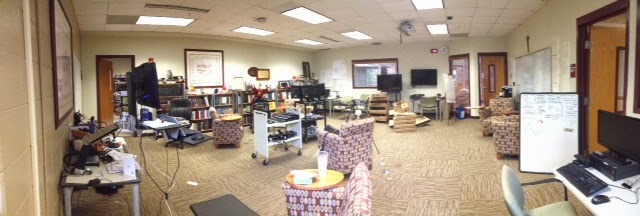
Panoramic shot of TRC during tech week
Purpose

In keeping with our Ignatian foundation, the TRC is a space for faculty and staff to experience and reflect on practices.  This can be as formal as an after school Ignatian Themes formation class or as informal as doughnut Thursdays.  The space is across the hall from the current library and will be remodeled as part of our Information Commons.  Visitors find comfortable/flexible furniture, web meeting software, a 3D printer,
complete set-up of classroom Extron system to experience and many print/electronic/human resources.  We also have a Keurig coffee maker and snacks (usually - Social Studies is quite the group of hunter/gathers and often clean us out).  Basically, anything a teacher would want to try before going into the classroom - we have the space to play.

Beyond space is the human relationship element.  In the picture above, you'll see three doors.  The door at 3:00 is my office.  While I moved into that office as Director of Faculty Development... I stayed when my responsibilities broadened out to Assistant Principal.  Why?  I like being close to the action of information services... I have more casual conversations about curriculum, technology integration and the values of DC over Marvel comics than I would if I had moved to the administrative suite.  For me, the relationships fostered by my location, and the ability to sit and have a cup of coffee with a colleague, trump anything else.

The door at 1:00 goes to the hall and the library.  The proximity to the library, and future integration into the Information Commons, highlights our resolve that learning, research and reflection is not just for students.  Students see adults engaged in new experiences, collaborating or working quietly... great modeling!

The door at 9:00 leads to IT offices.  Of course - you want to be close to the troubleshooters!   And yes, that is JD's mess about 7:30.  As I said in previous post, you have to make a mess to make progress and JD is the living image.

Reflection

Our 1:1 BYOT program was thought up, piloted, reflected on and implemented in the TRC.  From everything to chalk-talks to Tech Petting Zoos to department Boot Camps... we did it all in the TRC.  I strongly suggest anyone even considering a 1:1 or major technology or curricular shift create a TRC - a safe space for conversation and trial experiences.

What I did not anticipate is the organic conversations and connections made in the space.  Teachers meet in the TRC as grade level teams because the furniture allows for easy collaboration.  Cross-curricular discussions start up daily over the coffee maker.  Even students have been invited in to teach adults
how 3D printing can be used in the classroom (this will change with renovations as students will have their own MakerSpace in the Information Commons).  The space is used beyond any one technology initiative... discussion of curriculum, policy, evaluation process and assessments, architectural design, summer camps, athletics ... it all takes place in the TRC!


Key Elements

  • Flexible furniture!  You'll want to re-arrange space for large/small, formal/informal groups as well as individual work spaces.
  • The room cannot be on the meeting room schedule. We protect the space for organic experiences by keeping it off the Outlook room schedule.  
  • Everything in the classroom is present and available for faculty to try.  The TRC was a safe place this summer as we trained, practiced and reflected on the new Extron system installed in all classrooms.  This ensured on Day 1 that faculty were ready to go.
  • Don't forget print resources... some folks still like to curl up with a print book on curriculum design or classroom management and that's okay.  We cater to all users.
  • Quick access to people who can help.  In our case, the proximity to IT, Librarians and Administrators has made for quick actions to identified challenges (small and large).
  • And coffee really does help...

In the new space, the TRC will be a little smaller.  It's okay...really.  Through experience we have learned that the room is best used for small groups or 1 on 1 troubleshooting/brainstorming.  An intimate space for personalized support.  All the doors and offices stay put so the human side will not change.  Plus we'll have a great new space outside the door for collaboration with others!  

So that's the TRC in a nutshell, Nancy :-)  Glad you asked!!

Sunday, December 22, 2013

A Joyful Noise: An Examen for Teachers


In #catholicedchat yesterday morning, the topic of gifts was on the docket.  Gifts given and received.  Not an unusual or surprising topic given the season and the audience.  It just happens my personal Advent journey this year includes reading James Martin SJ's book Between Heaven and Mirth . Again, not terribly surprising given my day job and personality.  In Fr. Martin’s introduction “Excessive Levity”, he gives several reasons for the seriousness of religion.  He writes, “…the aim of religion is sometimes seen as one of overriding seriousness.” Basically, we don't laugh, dance or make a joyful noise to the Lord because... by goodness... Church is Serious!!  In light of recent news stories in Indiana (check out State Impact Indiana for dramatic details) and nationally (The Answer Sheet is always good for a depressing glimpse of the state of education reform), I think it’s safe to say the aim of education is sometimes seen as one of overriding seriousness. And heaven help those of us in both realms.

Lately, the seriousness has been bringing me down.

  Right now, if you are like me, the joy comes back after a day or two of 8+ hours of sleep and not obsessively checking email waiting for the other shoe to drop.  Joy is slowing down, spending time with friends and family and laughing.  I realize we don’t laugh enough in education.  We tell students to quiet down and we frown upon frivolity of Ugly Sweater Day as we busily read the state data reports to see if our school is on The Nice List or The Naughty List.  And we are unhappy. And those students we seek to serve are unhappy.  We create locked down atmosphere of serious study - every activity aligned to a standard and every classroom silent. We lose sight of the focus … children.  Broadening their horizons with messy experiences and time for reflection.  Children laugh… sometimes a lot… sometimes loudly, messily, obnoxiously and for no reason.  They are seldom full of overriding seriousness.


I found myself journalling yesterday on this concept of joy and my vocation.  The path I found myself on looks similar to what I write below and I thought some others might be interested so I offer you this Examen for Teachers.  (What's an Examen you ask?) 

  • Take a few moments to sit in silence – in a place that gives you comfort.
  • In this silence, see in your mind those laughing faces that made you want to be a teacher.  Bring to mind faces of former teachers, colleagues, students and parents.  Anyone who walks with you on your journey as an educator.
  • Fr. Martin writes that “Joy…. is what we’ll experience when we are welcomed into heaven.”  Recall the people and places where you were welcomed.  What did you see?  Hear?  Feel?
  • Reflect on what stops you from being joyful - those barriers which hinder feelings of welcome, comfort or laughter.
  • Overwhelm those barriers with earlier faces of joy.  If you are so inclined - pray for strength and patience overcoming these barriers.  
  • Be grateful for the faces which overcome the barriers.  Enjoy the welcoming calm. 
And with that I wish you a joyful holiday break fully of wonder, peace and laughter!